

Login
Log in if you have an account
Register
By creating an account with our store, you will be able to move through the checkout process faster, store multiple addresses, view and track your orders in your account, and more.
Create an accountNitto Racks, Explained
Who’s Nitto?
Simply put, they’re one of the last remaining great components manufacturers of Japan’s bicycle boom in the 20th century. Their specialization is, by choice, narrow: excellent stems, seatposts, and handlebars. All those are components they know they can make to higher standards than anyone else in the world. As almost a sideline, they make the very finest modern versions of traditional French racks, welded from tiny tubular steel and nickel-plated. Like all their components, the design is done carefully and manages to find beauty in subtle differences of curve and angle, while their quality control tests exceed internationally-recognized standards.
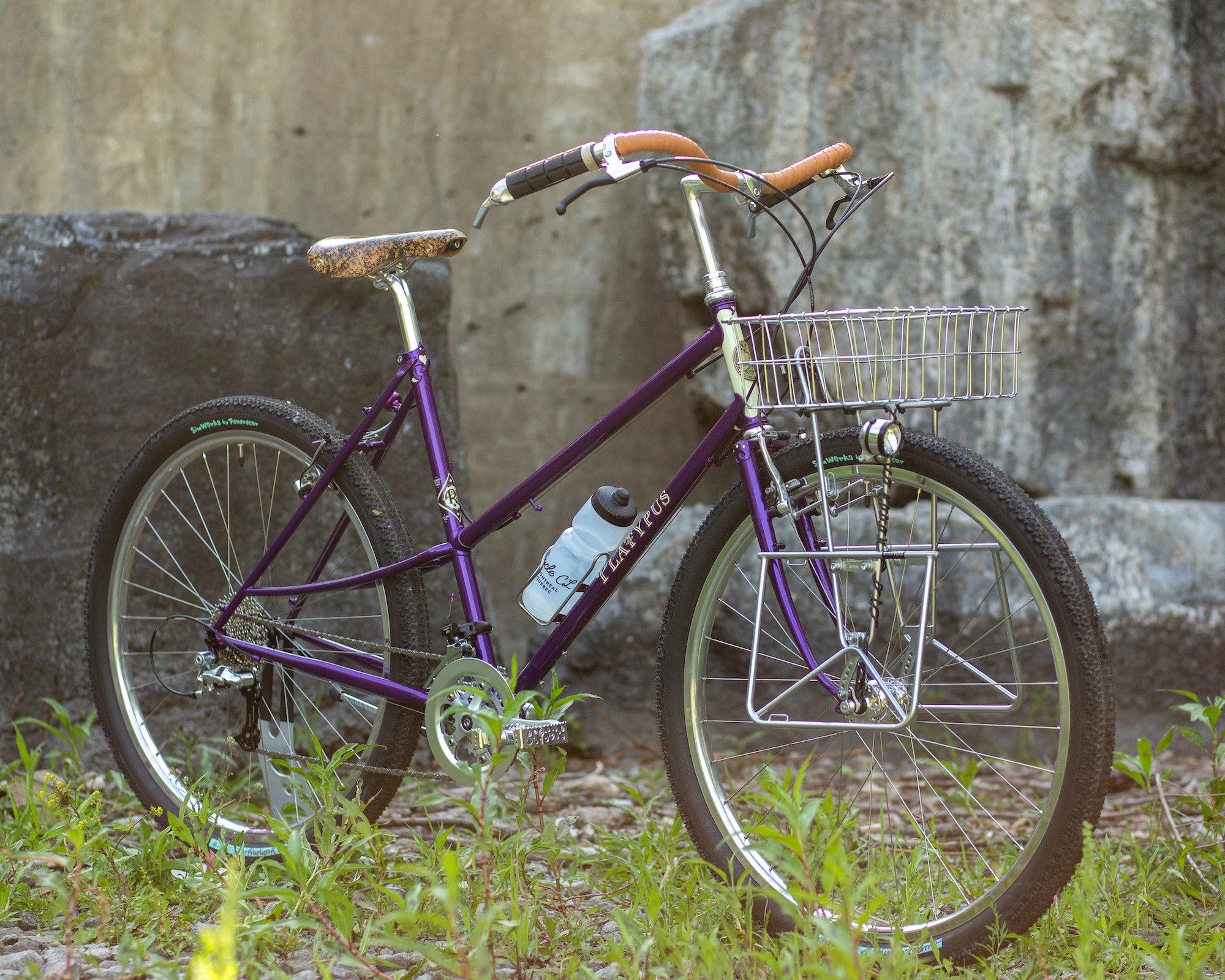
Header image: Rivendell Platypus with Campée 650F, including basket tied to the platform

A Rivendell Joe Appaloosa with Campée 650R, pannier wings removed
To get an overview of Nitto’s racks, we can split them into two categories: Tourist racks and Randonneur racks. Most of these serve great for other uses like city riding and bikepacking, but they're designed a certain way, so that lens is useful for us.
The Tourist Racks are large. They’re designed to carry enough gear to go bicycle camping relatively comfortably, and to be pleasant to cycle with all day long for weeks at a time. For stability, they bolt to secure spots pre-welded to the frame, which means they have a bit more hardware which adds weight, though this is mitigated by the lightweight tubular construction of the racks themselves. Many cyclotourists in the C&L crew can testify first hand, these racks are worth the high asking price: they stay beautiful and solid for a shocking number of years and kilometers of riding and touring.
 International touring icon Kellyann Marie, captured on Ektar film with pink Soma Saga and Nitto Campée 650F
Our friend and ex-colleague Kellyann, above, has been riding their Campée Front since 2020: Newfoundland (and some Labrador), Iceland, Europe twice, Florida thrice, Eastern Divide from Florida to Montreal, and many more smaller adventures. Their one regret, in their words, is not getting the rear to match when it was in stock at C&L. I’ve seen their bike recently and I’m astonished that the rack looks almost like new after so much use (and so many flights!).
There are basically three Tourist racks, and a couple of size variations.
Campée is the flagship model. It’s the full package, attaching to dropout eyelets and to somewhere on the fork blades or seatstays: cantilever bosses, threaded eyelets, P-clamps, what have you. They can also help support fenders, and you can do bags on top and on the sides: the wide side-wings help stabilize full pannier bags, and are easily removable to save space and weight if you’re not going full-tourist that day. Many also use them with a basket strapped to the top, as you can see in our bike photos.

Nitto Campée Front
It comes in front and rear versions (designated F or R in the product name) which is pretty self-explanatory. A lot of us like the front, since a slightly heavier front than rear load tends to handle better on bad roads (why isn’t front-loaded touring the default? It’s a bit less aerodynamic. Up to you if you care).

Nitto Campée Rear
There are two Campée sizes: 27 and 650. The 27 fits bigger-wheeled bikes, be they 27-inch, 700C, 27.5”, etc. They might not work with super duper maxed-out 29ers, mind you. The smaller 650 is made for 26-inch and 650B wheeled frames, and probably fits if you have skinny 700C wheels. If in doubt, measure from the specs on the product page!

MT-R20 Rear Rack
MT-R20 Campée is a bigger-platformed, simplified rear rack, designed for smaller 26-inch and 650B wheeled-bikes, though there’s clearance for non-super-huge 700 wheels too. The simplicity lowers its price, and it’s just as well-designed and finished as the fancier models.
The Randonneur racks are teeny-tiny, and quite light! Randonneuring is a sport where cyclists ride far and quickly, not in a group, and where the point is to finish, not to win. Therefore riders tend to want to carry a little bit of gear, like repair tools, light jackets, and food, but without adding too much weight or interfering with handling. Reliability is important since a broken rack or bag can cause a rider to not finish an event they’re trained for, and the rides are so long that they inevitably have long sections far from help. Therefore, Rando racks are bag-support racks. The bag would generally also be attached to the bike, though it’s not mandatory. It’s a belt-and-suspenders thing, but also helps distribute the weight a bit more comfortably.
They’re also used for city bikes, where a little bit of extra cargo capacity is always useful. The Rando racks aren’t meant to be really weighed down with a full load of groceries, but can help carry your everyday bag. The racks are pretty popular and they take Nitto a really long time to make because of the fine, precise welds, so they can be out of stock for many months (this isn’t a C&L thing, all Nitto distributors have this!). It’s a good idea to plan ahead for your bike build.

The M18 Rando is the traditional model that’s adaptable to most bikes that have mounting eyelets. It attaches to the fork blades and to the fork crown. The cargo capacity is 5kg (11lbs, that’s a large sack of all-purpose flour from the grocery store) so it’s not meant as the primary cargo rack, more of a bag support or lightweight basket-rack.

The M1 Mark’s Rack is like the M18 and has the same weight capacity, but was co-designed with Rivendell to be a little more adaptable to different bikes. The double stay setup lets you attach it to more forks, and would in principle make it a bit sturdier, though the point is the mounting flexibility. You can mount it front or rear.

The R14 is also a bag rack, but for the rear. For example, it greatly enhances the stability and capacity of something like a Carradice Camper bag, which can sway a lot if it’s weighed down and doesn’t have extra support. Since it’s larger and the stays triangulate it better, the capacity is almost double the M1 and M18, at 9kg (20lbs), and the weight of a rear bag would normally be supported by the saddle and seatpost, not just by the R14. This rack can sometimes be installed on the front, but it’s not made for it so it’s up to you to see if your specific bike works for this. Rivendells often do and so does the Hog’s Back.
Other rando racks from Nitto exist and we occasionally have them, like the 32F. That one is the lightest one but is super-specialized, since the mounting stays aren’t adjustable. It fits the Bassi Belmont super easily but if your bike’s fork design is much different, you’re out of luck.
Do you want to use these racks with a basket? No worries for the Campée models, have fun and express yourself, but be more careful with the bag-support Rando racks. It's super doable but it's easier to overload the rack if you're filling up a basket than a small bag. Stick to the smaller Wald 137 (or even the half basket) and be aware that other, stouter racks might be better suited to heavy basketfuls.
All the mounting struts for Nitto racks are interchangeable! Their diameter is 7mm, and we try to stock a few lengths since depending on the exact project, the stock ones might not be perfect. They’re not hollow, but rather are aluminium rod, so they can be bent a little bit and cut to size where needed. Since they’re all the same diameter, there are also accessories available for the stays, like light mounting brackets.
The hardware included with Nitto racks is also top-shelf stuff, they don’t like to take a chance that anything could vibrate loose. That said, always check the bolts’ tightness before a ride, especially if you load your racks with close to their maximum capacity. A safety strap leading from the rack to your handlebars is recommended for front racks, since they can be extra dangerous if they fall into your wheel.
Most of the racks come with P-clamps in case your frame doesn’t have welded, threaded mounting points. Like all the included Nitto hardware, they’re very high quality, but if you’re using them please keep an eye on them especially if you’re near the load limit for the rack, they’re less stable than proper eyelets.
As always, let us know if you have questions about our racks! Your local bike shop can get Nitto in Canada exclusively through C&L Cycles distribution.
Leave a comment
Recent articles
View all
A recap of our small Toronto visit
The story of the Allotec A32, aka Bassi’s first fork crown
Comments