Julian Gammon
Nov 5, 2026
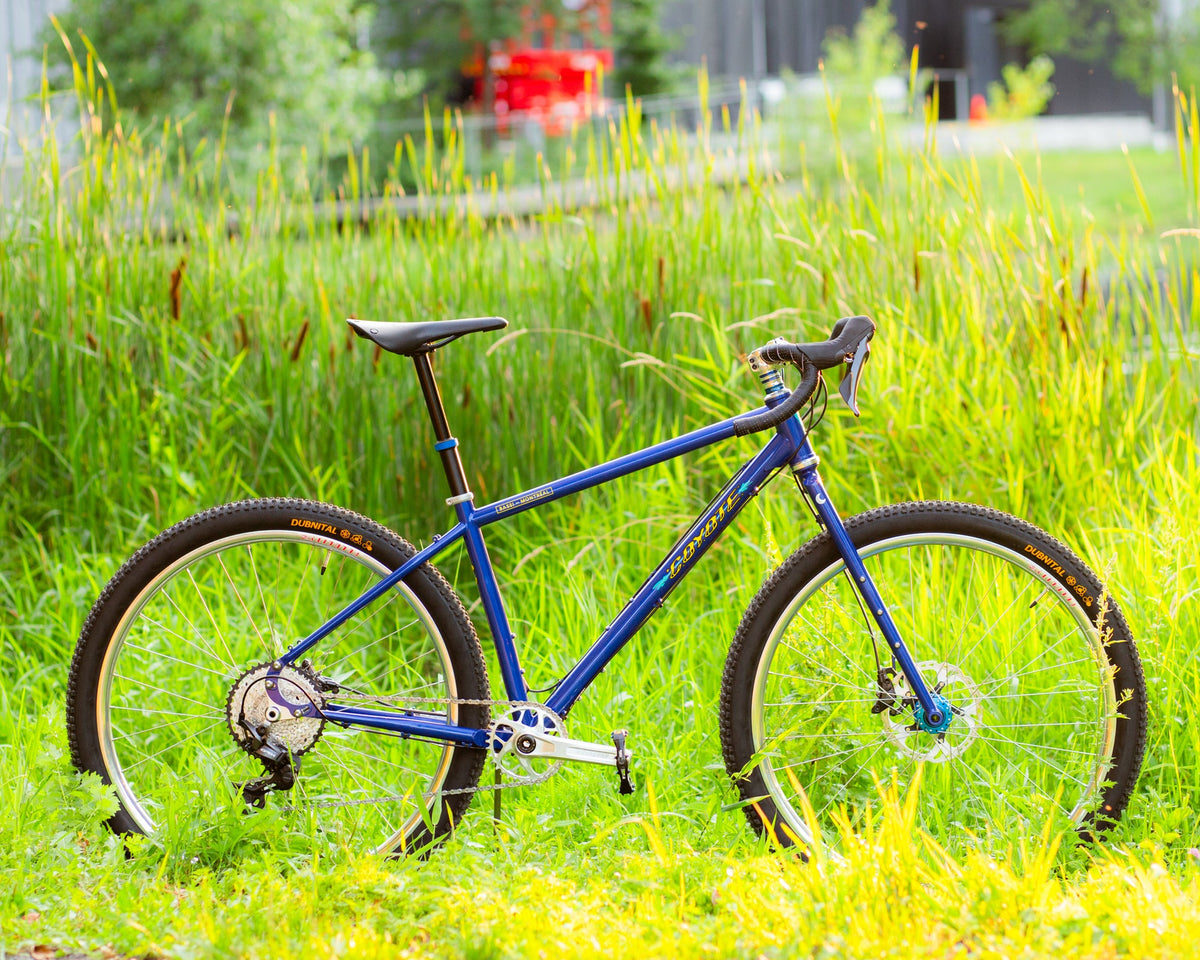
Check out Mech Manager Vince's take on a custom Coyote build! Ever the ardent lover of drop bars, he set off to showcase his vision of a (monster)gravel-oriented Coyote.
This build had been on my mind for a pretty long time. I think the Coyote is one of the most underrated models in our current roster, and I believe it’s because its intended use and capabilities are misunderstood. What kind of bike is it really? We clearly state on our website that it is not a mountain bike. It’s not a touring bike in the traditional sense. A certain reviewer called it a gravel bike, which I think is a bit far-fetched. When asked, I simply call it a bikepacking bike. That term, “bikepacking”, is still extremely vague and has many different definitions depending on who you’re asking, but generally speaking I’d say a “mountain-ish bike made to load up with gears and ride all day mostly on unpaved roads” is a rather adequate description. Admittedly, the categories for off-road oriented bikes have kind of all melded together over time, and the lines separating a gravel bike from a bikepacking bike, an adventure bike, or whatever what else they’re called, are rather blurred. At this point I tend to see this whole category as a spectrum, at the left end you have performance-oriented and kinda road-like gravel bikes and at the other end you have touring-oriented mountain bikes. Your average popular gravel bike from the Big Four would likely fall somewhere between the left and the midpoint on the spectrum, the Hog’s Back would fall pretty much in the middle of the spectrum and the Coyote lands somewhere between the center and the right end. Thinking about it as I’m writing this, a more accurate representation would probably be a 2-axis spectrum, like a political compass, with left-to-right axis being smoother vs. rougher terrains, and up-and-down axis being performance vs. load-carrying. But having such a vague category for a bike means that it’s likely more adaptable and versatile than a single-purpose bike would, and this is what I wanted to show with this build.
The tinkering around this build started about 2 years ago while on a trip to Columbia with a group of friends. Roberto, Bassi co-owner and designer of the Coyote, was among the group with his personal Coyote. Since we both ride the same size frames we got to swap bikes for a bit to shuffle things around, and while riding his bike I remember thinking “So this is what it feels like to not be underbiked!”. My own bike was entirely suitable for the route, but his Coyote just felt like the exact tool needed for the job. I think this is mainly due to 2 factors.
First, the wheelset. Even if the terrain wasn’t particularly rough and with few technical sections, the extra plush of the 2.4” and the roll over of the 29” made the ride noticeably more comfortable. It just felt like it was eating rocks instead of fighting against them. Also maybe something could be said about bigger wheels being more compliant, but I’m not sure how noticeable this could really be.
The second factor is the frame geometry. For a mountain-leaning frame, the geometry is still pretty conservative, which is exactly what I like. I’m personally not a fan of high-trail bikes for all-around touring if it is to be front-loaded. I do understand wanting the added stability provided by a higher trail, but the way I see it, front-loading your bike will already help stabilize the front end. Not only that, but the weight on your fork will also accentuate the wheel flop effect. All this means you end up with a bike that is slower to steer and also requires more input from you to resist wheel flop. Most high trail bikepacking bikes just push this too far to my liking.
This helps to stabilize the front end, which also requires more input from you to steer and fight wheel flop (which is also accentuated by the front load). The Coyote felt very stable and planted when descending, while remaining pretty nimble and easy to manoeuver.
So with all this in mind, my idea for this here Coyote was to build the bike I would have liked to have back in Colombia or for similar types of riding. This would be a pretty easy exercise for me if it was actually my own bike, but building it for the shop has an added layer of complexity: it needs to be sellable. By this, I mean that it needs to be appealing to a broader audience, both in terms of functionality and aesthetic. Be cool and special, but not too personal. Be niche enough, but not too niche. Now if you know me or have seen my bikes on here, you might notice the end result doesn’t look like a bike I would own. It’s too fancy, too indexed, too polished and clean looking. But this was actually a fun exercise for me, to put myself in the average Bassi/C&L customer’s shoes and understand what it is they might want. It pushes me to try new things, see what’s popular and why, and try to make a visually appealing bike for once.
The biggest difference from Bobby’s Coyote obviously resides in the handlebar choice. While I do think the Bobby Bar is the best bikepacking flat bar around, I personally vastly prefer drop bars for all-day riding. But I was worried that having an adequate reach with drop bars might be a problem. Generally speaking, bikes falling towards the mountain bike side of things have longer front ends, which will sometimes force certain riders to go for a frame one size smaller if they want to run drop bars (this is what we usually recommend for the Hog’s Back). But when looking more closely into the geometry, I noticed something interesting: compared to a Hog’s Back, the Coyote’s “reach” is actually shorter. I put “reach” in quotation marks because I’m not referring to the actual reach measurement that is used by most of the industry, because that measurement frankly doesn’t say much when isolated from the rest. Reach is defined as the horizontal distance between the imaginary vertical line crossing the center of the bottom bracket and the center of the top of the heat tube. But that doesn’t tell you how far you are sitting behind the bottom bracket. Trigonometry (or playing around with BikeCAD) will tell you that, for a saddle height of 75cm, a difference of 1° in the seat tube angle would move your saddle horizontally by about 1cm, i.e one size stem.
Then, something similar can be observed with the head tube angle. While the frame reach doesn’t change with a different head angle, your grips’ position in space does. So, again, a 1° difference in head angle can mean 1cm or more in horizontal distance. When comparing the numbers between a Coyote size M and a 54cm Hog’s Back, on paper the Coyote does have a longer frame reach (430mm vs 412mm), but it also has a steeper seat tube angle (74° vs 73°) and a slacker head tube angle (68.5° vs 72°). So if you were to maintain the exact same fit between the two frames, you would likely end up with a 30-50mm longer stem on the Coyote than you would on the Hog’s Back. Bonkers!
Okay now on to the build kit. Settling on the components specs was quite simple. While I’ve never had it on one of my bikes, I grew to appreciate the functionality and options offered by Shimano GRX. Both 1x and 2x options give pretty sensible ratios for off-road riding and bikepacking, and it turns out the brifters are maybe the most comfortable I ever got to ride/test. The 12-speed 10-45 cassette paired with a 34t chainring provides ample range for both faster riding and long climbs. I will be honest that the main thing that made me choose GRX is that the left lever is compatible with dropper posts, which I think is the coolest thing Shimano has ever done. Dropper posts aren’t a very popular tech here at C&L, myself I have yet to adopt them on all my off-road bikes. That being said, I do believe they are an added benefit when riding technical sections.The one downside of this groupset is that I found myself obligated to use hydraulic brakes, which simply isn’t my preference, but will likely be the preference of many others. For the handlebar I wanted a no-nonsense and very wide dirt drop, and I really like what Tumbleweed makes in general, so the Big Dipper was an easy pick.
When I was about done with the parts’ specs, style and aesthetic still needed to be sorted out. What frame colour? What parts would better fit the style? Should I add certain color accents? And all this questioning eventually turned into a challenge: in 2026, can you build a mountain-y bike with (almost) only silver parts? Turns out that mountain bike brands are pretty much the last bastion of silver (and other beautiful anodized colored) parts. I already knew I wanted Hope hubs, so I was pretty excited when I found their Evo crank in silver. When I ordered the parts I didn’t realize I was off specs by getting a 34t chainring (32t is the official maximum chainring size), but turns out it fits comfortably. Next, Velocity and White Industries were obvious choices for silver rims and headsets, and that Chromag stem had quietly been waiting on the shelf on Rachel to be picked up for such a build. Then, the dropper post would be the obvious problem. Well, I didn’t think it would be at first, because I had heard about the PNW Loam. Actually, the silver dropper post was the one component that sent me down the path of the all-silver build. Imagine the disappointment when I found out that it was only a limited edition and that they had no plans of making it again! I searched every corner of ebay, Pink Bike and whatever would come up on Google for the one remaining silver, 30.9mm, 150mm Loam dropper post, sadly to no avail.
So in the end I had to settle on a simple black dropper, with the blue band as a consolation price. I don’t want to say that it kind of ruins the whole build, but with that much seatpost showing I do think a silver dropper really would’ve been the part that ties it all together. Eh, in the end, if I can stop being dramatic for a minute, the bike does look amazing. This little episode was simply a reminder of the absolute aversion this industry has for silver parts and of the general aesthetic direction it is taking (the wrong direction if you ask me).
My riding of this bike is limited to the Lafontaine Park and the kids’ bike course/playground while Troy was shooting pictures, but I can say with total confidence that this bike is a whole lot of fun! It feels exactly how I imagined it, which is playful, confident, comfortable yet sporty, and just all around very cool. At 5’10” with long arms, the final fit is a bit aggressive for my liking, but with the current 30mm stem I would say it would be a great fit for someone between 5’7”-5’9” and short arms. For me, that would be the perfect bike for singletrack- and rough-road-heavy tours. The irony is not lost on me that I ended up building a kind of beefed-up gravel bike while mentioning that categorizing the Coyote as a gravel bike seemed inappropriate. But again, what’s the difference between a monster-gravel bike and a drop bar mountain bike? Is frame geometry what defines a mountain bike? Are gravel bikes limited to drop bars? Well, as you might guess, I have my own opinions on this, but that will be for another time.